

Measuring Court Performance: The Rise of Data-Driven Judicial Administration
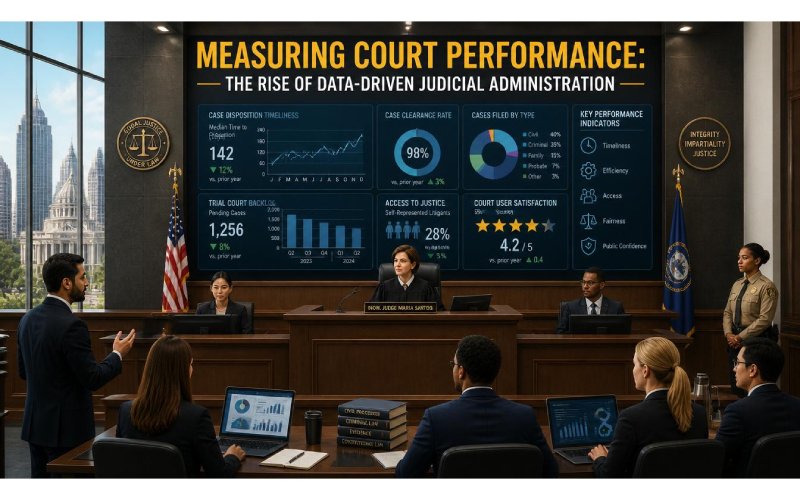
For thousands of years, as humans have evolved, so have our legal and judicial systems. And for thousands of years, civilisations have struggled with one very fundamental question:
How do we know if our judicial system is actually working?
In ancient Babylonia or Norman England, an effective court was anything that halted disputes before it spiralled into a bloody family feud. As the verdict often carried a touch of divinity, courts relied on oaths to local deities or GoT-style trials by combat to ascertain ‘absolute truths.’ In Europe, as kingdoms expanded and Napoleonic Code took root, courts shifted from religious rituals to imperial bureaucracies. The performance metrics shifted from divinity to procedural perfection and administrative control. A court was deemed successful if its written records were flawless and if it could withstand a review by a distant royal authority.
In the 20th century, industrialisation, urbanisation, and the consequent surge in commercial litigation pushed bureaucratic courts to their breaking point. Courts began to view themselves not just as halls of justice, but as public service pipelines that needed to process massive volumes of work. The world was introduced to foundational judicial statistics and for the first time, court performance was measured mathematically using standardised operational formulas. Quantitative throughput and volume replaced the metrics of precision and control. What happened between filing and final disposition remained hidden inside the judicial machinery and very few people were allowed closer examination.
Fortunately, today, that is changing.
Why are Traditional Metrics No Longer Enough?
Historically, courts have relied on a relatively narrow set of indicators to assess court performance. Metrics such as case clearance rates, case disposition times, backlog volumes, etc, usually were considered the benchmarks for evaluating judicial efficiency. While they remain important and continue to provide valuable insights into the operational health of court systems, they tell only part of the story.
A court may dispose of cases quickly while still creating barriers to access. A judiciary may achieve impressive clearance rates while litigants remain dissatisfied with the quality of service they receive. Likewise, a reduction in backlog may conceal deeper procedural inefficiencies that continue to affect the user experience.
In the face of these limitations, judicial organisations around the world have ardently sought out a broader understanding of court performance – one that identifies a range of values that extend well beyond efficiency alone.
How is Judicial Performance Measured Today
Today, the legal landscape recognises that treating courts like industrial age automated assembly lines can compromise the quality of justice; and that simply counting closed cases is no longer enough. Intuition is no longer enough. This realisation has prompted the 21st century shift towards holistic, data-driven judicial administration that evaluates a court’s health through multiple parameters, cross referencing case complexity, financial expenditure, and digital accessibility, among several other criteria. Across the world, courts are now expected to deliver justice that is not only fair, but also timely, transparent, accessible, and accountable. We have come to expect the same promptness and responsiveness from legal and judicial organisations that we receive from digital services in our everyday lives.
Safe to say, a quiet, yet profound transformation is afoot. Courts are beginning to move beyond anecdotal decision-making and embrace a more evidence-based approach to governance. Data, once collected primarily for reporting purposes, is increasingly being used to understand performance, identify bottlenecks, allocate resources, and improve the delivery of justice itself. Current judicial institutions are no longer debating if our legal systems work, but rather they are overwhelmingly concerned with:
How do we make our judicial systems work better?
The shift is subtle, but its implications are significant. The realisation that quantity cannot be separated from quality was revolutionary. It led to the creation of globalised, standardised, and actionable performance frameworks that used data that was previously collected for monitoring and reporting purposes to set up elaborate systems that established the institution’s transparency and built public trust.
The objective is not simply to count cases but to understand the broader quality of judicial administration – measure judicial performance through a holistic approach that focuses on productivity and overall institutional effectiveness.
What is Data‑Driven Judicial Administration, and How is it Transforming the Justice System?
Courts have always collected data. The difference today is that they can finally use it.
Courts today generate vast amounts of operational information. Every filing, deposition, hearing, adjournment, judgment, and procedural event leaves behind a massive digital footprint. Case Management Systems (CMS), e-filing platforms, scheduling tools, virtual hearing portals, and online services now produce data at a scale that was unimaginable only a decade ago. The challenge facing courts today is no longer the collection of information. It is knowing what to do with it.
Instead of relying solely on historical reports, court administrators now have enough information to monitor court activity in real time, identify emerging trends, and intervene before operational issues become systemic problems.
It is the same evolution that is mirrored in other sectors. Airports do not simply count passengers. They monitor queue lengths, wait times, gate utilisation, staffing levels, and throughput rates. Hospitals do not measure success solely by the number of patients treated. They examine treatment outcomes, patient satisfaction, resource allocation, and service accessibility. With progress in court technology and the easy availability of necessary data, courts are increasingly beginning to think in similar terms. This does not mean reducing justice to a spreadsheet. Rather, it means recognising that judicial institutions can only improve what they can understand.
And understanding begins with data.
What are the Technologies Driving this Transformation?
Data-driven judicial administration has been made possible through a parallel transformation in court technology. Today, a new generation of digital technologies have managed to successfully transform court operations. These systems, in digitising paper-based processes, generate structured information that allow courts to monitor efficiency, identify bottlenecks, and support evidence-based decision making.
- Digital Case Management
Digital case management is often considered the foundation of effective court administration. Modern Case Management Systems (CMS) record every stage of a case’s lifecycle. Each procedural event is captured as structured data that in turn allows courts to measure its performance through multiple parameters, with nuance and greater accuracy.
- Judicial Dashboards
The value of data lies in its accessibility. Judicial dashboards consolidate information from multiple systems into real-time visual indicators that help administrators monitor key performance metrics such as pending caseloads, judicial workload, hearing schedules, and clearance rates and make informed decisions and improvements.
- Artificial Intelligence and Predictive Analysis
Rather than replacing judicial discretion, today, Artificial Intelligence is being used to augment administrative efficiency and preserve judicial independence. Courts are increasingly deploying AI to help with case classification, document analysis, workload forecasting, and predictive analytics among other administrative applications to identify emerging trends and allocate resources proactively before they become systemic issues.
- Workflow Automation and Interoperability
Through compliant checks and balances woven into the digital fabric, routine administrative tasks such as case registration, scheduling, notification, etc are now being automated. This reduces manual effort while improving consistency and accuracy. When supported by interoperable systems that securely exchange information across courts and other justice agencies, these technologies reduce duplication, minimise delays, improve data quality and generate comprehensive datasets for end-to-end performance measurement.
- Digital Identity and Electronic Signatures
Secure digital identity checks and electronic signatures are now being used to equate trustworthiness in digital justice. Creating verifiable audit trails for every transaction, they have now become the cornerstones of modern digital governance, supporting both operational efficiency and the integrity of judicial performance data.
Together, these technologies provide courts with the infrastructure needed to move beyond archaic or anecdotal assessments of court performance. By generating accurate, timely, and interconnected data, they enable judicial administrators to monitor operations continuously, allocate resources more effectively, and make decisions grounded in measurable evidence.
What are the Key Challenges Facing Data‑Driven Judicial Administration?
The case for data-driven judicial administration is compelling for sure. But technology alone is not the panacea to lacking court performance. Like any major reform, its success depends on how thoughtfully it is implemented. Even with the leaps and bounds made in technology there are still certain challenges that need solving:
- Data Quality: Performance metrics are only as reliable as the data behind them. Inconsistent data entry, fragmented legacy systems, and incomplete records can undermine the value of performance indicators. Establishing common data standards and robust governance is therefore just as important as investing in innovative technology.
- Judicial Independence: With growing dependence on technology, the case for safeguarding judicial independence is now more pressing than ever before. While data and AI can support administrative functions, they can never be allowed to dictate judicial reasoning or judgements. The role of technology is to improve how courts operate, not how judges interpret the law.
- Privacy and Security: Massive amounts of sensitive, personal, and legal information pass through courts every day. As more judicial processes become digital, ensuring secure data storage, access control, and compliance with privacy regulations becomes essential to maintaining public trust.
- Organisational Culture: Digital tools can only deliver value if judges, court officials, and administrators are willing to adopt them. This calls for investments not only in technology but also technology training, change management and leadership that encourages innovation.
- Digital Divide: Not all court users have equal access to digital services. Poor Internet connectivity, digital literacy, and accessibility needs are still pressing concerns even in most developed nations. As courts modernise, they must ensure that technology expands access to justice rather than creating new barriers.
These, however, are not reasons to slow the pace of digital transformation. Rather, they are reminders that effective data-driven judicial administration depends as much on governance, people, and policy as it does on technology itself.
How Does Data-Driven Judicial Administration Actually Help Courts
At its core, data-driven judicial administration enables courts to move from reactive to proactive decision making. Instead of relying on manual reports or observations, court administrators can now monitor performance in real-time. Metrics such as clearance rates, case age, judicial workload, and disposition times provide an objective view of how efficiently a court is functioning and where resources are most needed.
The actual benefits, however, extend beyond operational efficiency.
Reliable performance data supports better organisation of resources and informed policy decisions and planning, yes. But it also strengthens transparency so courts can communicate better with the government, legal professionals, and the public at large. There is a general consensus among institutions concerned with judicial performance that meaningful performance measurement is not about comparing courts, but about enabling continuous improvement, fostering trust, and delivering better justice.
What This Means for the Future
The rise of data-driven judicial administration signals a broader shift in how courts are governed. Traditionally, court administration focused on managing resources, schedules, and procedures. Increasingly, it is becoming a strategic function – one that uses evidence to improve how justice is delivered.
This does not mean courts will be governed by numbers alone. Rather, data will become another tool that helps judicial leaders make informed decisions about policy, resource allocation, and service delivery. Performance measurement will move beyond simply reporting on what has happened to asking why it happened, what can be improved and how reforms can be evaluated over time.
This shift also reflects changing public expectations. Citizens increasingly expect justice systems to be as transparent, accountable, and responsive as other public institutions. Measuring court performance is no longer viewed as an administrative exercise, but as a means of strengthening public trust and demonstrating that justice is being delivered effectively.
Ultimately, the future of judicial administration lies not in collecting more data, but in building courts that continuously learn from it. The most successful justice systems will be those that combine technology with sound governance, ensuring that evidence informs improvement while the fundamental principles of fairness, independence and the rule of law remain firmly at the centre of every decision.
Author Bio
Vani Sriranganayaki
Writer, editor, and Head of Communications, Vani draws on over a decade of expertise in publication and communication to explore the evolving world of technology. Through her work with Justice Accelerator – a platform advancing digital justice – she crafts impactful narratives at the crossroads of legal innovation and tech, driving change forward. Reach her at vani.s@elint.in

Website Archiving for Legal and Compliance Teams

Can an Emergency Justify Violating a Distracted Driving Statute?

Who Is Liable When Space Debris Falls Back to Earth?

How Negligence Affects the Outcome of an Injury Claim