

How Bail Bonds Work: A Complete Guide to the Bail Process and Your Legal Rights
- News 08 July, 2026
After an arrest, the affected party actively looks for bail and searches for ways to release from jail before the criminal case is resolved. In many cases, the court allows the defendant to remain out of custody by posting bail. However, it is not a free service. You are required to pay a standard sum, which varies from state to state, to take bail. To manage bail costs, many people choose bail bonds and treat them as an affordable alternative to traditional bail expenses.
In this article, we will understand how bail bonds work, court requirements, legal obligations, financial responsibilities, and more, so keep reading.
What Is Bail?
Bail works as the financial guarantee that a defendant returns to court for all required hearings after being released from custody. For deciding its amount, a judge usually considers:
-
The seriousness of the alleged offense
-
The defendant's criminal history
-
Risk of fleeing before trial
-
Community ties
-
Public safety concerns
What Is a Bail Bond?
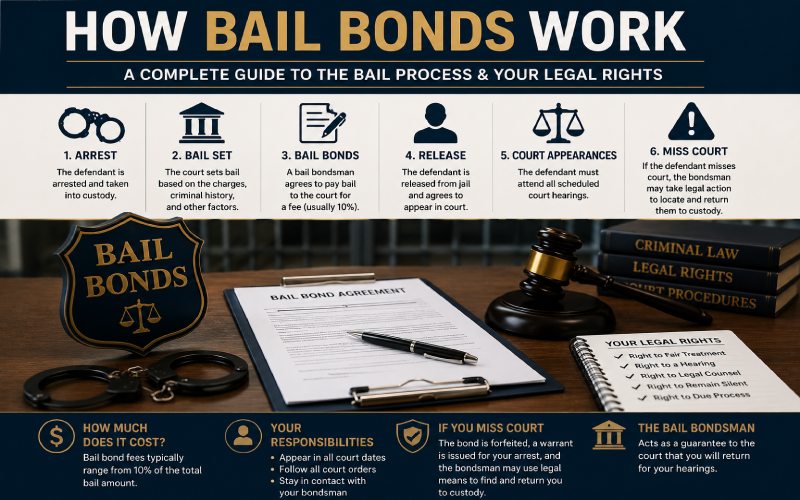
It is an agreement between a defendant, a licensed bail bond company, and the court. It typically involves three parties. Here, the concerned person or, on their behalf, a non-refundable premium is paid to a licensed bail bond company. In return, the company takes the guarantee of fulfilling the payment requirements of the full bail amount if the defendant fails to appear in court.
How Does the Bail Bond Process Work?
-
The Court Sets Bail: After arrest, the court determines the eligibility for bail and the amount required for it. Some offenses are prequalified for release based on a predetermined bail schedule, while others require a formal bail hearing.
-
Contact a Licensed Bail Bond Company: If the full bail amount is not financially possible, the concerned person or someone on their behalf may contact a licensed bail bond agent. They will review your case details to determine your eligibility and other details.
-
Pay the Premium: In this stage, you pay the premium amount, which is generally expressed as a percentage of the total bail amount, and it is usually not refundable.
-
Provide Collateral (If Required): A bonding company may ask for collateral to secure the bond. Collateral can be any valuable asset, such as real estate, vehicles, jewelry, and other assets as deemed ideal by the company.
-
Release From Jail: Once the bond is approved, the defendant is released from custody with certain restrictions and an obligation to appear at every scheduled court hearing.
What Happens if the Defendant Misses Court?
It is a serious offense and can result in:
-
An arrest warrant
-
Revocation of bail
-
Forfeiture of the bond
-
Additional criminal charges in certain cases
-
Financial liability under the bond agreement
Can Bail Be Denied?
Yes. Because bail is granted after careful review of facts, and generally denied for:
-
Serious violent offenses
-
Significant risk of flight
-
Repeated violations of prior release conditions
-
Threats to public safety
What Happens After the Criminal Case Ends?
After the criminal case ends and the defendant has complied with all court appearances, the following things can happen:
-
Cash bail paid directly to the court may be refunded, subject to deductions authorized by law.
-
The premium paid to the bail bondsman is usually not refunded.
-
Any collateral provided may be returned after all bond obligations have been satisfied.
However, the outcome may differ in real scenarios due to various factors, such as the terms of the bond agreement, applicable state law, and more.
Responsibilities While Released on Bail
Release on bail is temporary in nature and comes with several responsibilities, such as:
-
Appearing at every court hearing
-
Obeying all release conditions
-
Avoiding new criminal charges
-
Keeping the court and bail bond company informed of address changes
-
Remaining within any travel restrictions imposed by the court
Common Mistakes to Avoid
-
Missing court appearances.
-
Ignoring release conditions.
-
Failing to read the bond agreement.
-
Assuming the premium is refundable.
-
Providing inaccurate information to the bonding company.
Frequently Asked Questions (FAQs)
What is the Purpose of a Bail Bond?
A bail bond is a facility that allows a defendant to take bail without paying the full amount. Here, they are required to pay a premium to the company, which is generally non-refundable.
Do You Get Your Money Back After Using a Bail Bond?
No, in general cases, money paid as the premium for the bail bond is non-refundable.
What Happens if Someone Released on Bail Does Not Appear in Court?
It is a serious offense and attracts both legal and financial penalties. Also, your future bail possibilities are reduced significantly.
Conclusion
Bail bonds are a useful facility for defendants who are financially weak and don’t have enough money to pay the full bail amount. They can opt for bail bonds by paying a premium amount to a licensed bail bond company. This amount is generally non-refundable. However, before taking this service, we recommend that you consult an expert legal professional to make informed decisions.


Protecting Your Wealth in Divorce

The Hidden Costs of a Personal Injury: Why Acting Fast Matters

The Hidden Risks of Parking Lot Accidents at the Beach

Legal Drinking Age in Florida: What Every Parent and Minor Should Know


Moving to New Zealand With a Partner: Understanding the Visa Pathway

How Professional Licensing Can Be Affected by Criminal Convictions

What to Do When an Insurance Company Disputes Your Accident Claim?